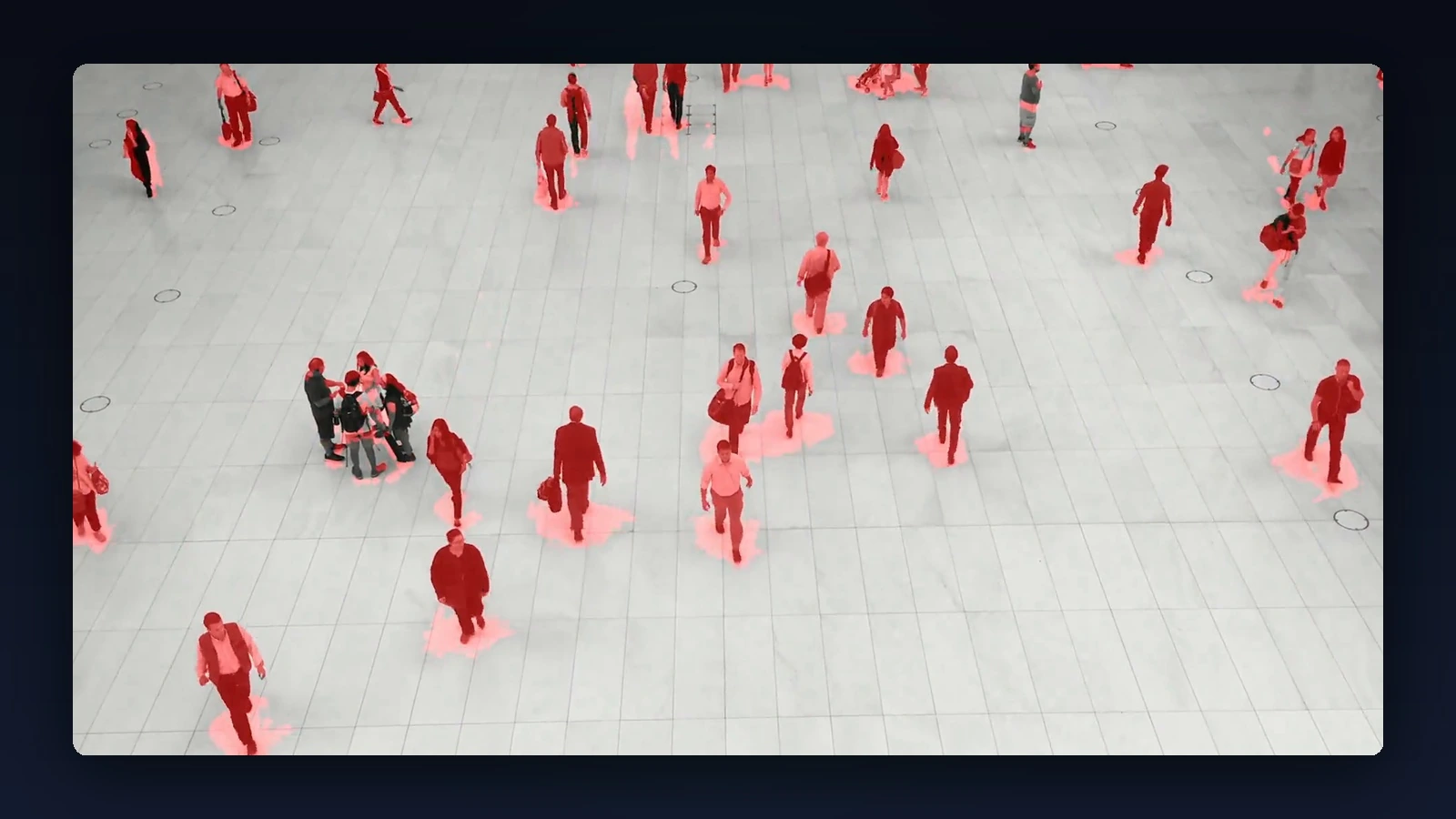
Context & Problem Statement
Real-time motion detection is a fundamental building block of video surveillance systems, automated video stream analysis, and robotics. The objective of this project was to design a background subtraction filter capable of operating at 30 FPS or higher in High Definition, constrained to rely strictly on NVIDIA CUDA and the GStreamer multimedia framework.
Technical Challenges
- CPU Bottleneck: The reference sequential C++ implementation achieves only 5.29 FPS — far below the 30 FPS real-time threshold.
- High Data Parallelism Pipeline: Every pixel in every frame undergoes 5 sequential independent operations, an ideal use case for GPU execution, but memory, random generation, and morphological bottlenecks required in-depth analysis.
- Rigorous Validation: Every CUDA optimization must maintain near-perfect visual precision compared to the CPU reference (SSIM ≈ 1.0000).
Pipeline Overview
Processing is executed frame by frame across 5 sequential stages, where each pixel is processed independently — an architecture perfectly suited for GPU parallelization:
The Motion Detection Algorithm
Step 1 — Background Estimation
The most complex stage of the pipeline. For each pixel, a set of K = 3 color reservoirs (color + weight) is maintained to model possible background colors (noise, lighting shifts, etc.).
For each new frame and each pixel:
- If the pixel color is close to an existing reservoir (tolerance of ±10 per channel), its color is updated by a sliding weighted average and its weight increases.
- If no reservoir matches, the weakest reservoir is replaced stochastically (probability inversely proportional to its weight).
The estimated background for each pixel is simply the color of the reservoir with the highest weight.
Step 2 — Motion Mask Calculation
The difference between the current pixel and the estimated background is measured via the L₁ norm (mean absolute difference across R, G, B). A high score indicates a pixel in motion.
Step 3 — Morphological Opening
The raw mask contains noise (leaves, video compression artifacts). A morphological opening on a disk of radius R=3 eliminates false positives:
- Erosion: Removes isolated noise pixels.
- Dilation: Restores the true size of detected objects.
Step 4 — Hysteresis Thresholding
Ensures spatial consistency: pixels with a high score (> 45) are strong seeds. Low score pixels (> 20) are retained only if they are adjacent to a strong pixel (propagation via 4-connectivity), until global convergence.
Step 5 — Motion Coloring
Validated pixels are colored in transparent red on top of the original image, visualizing motion while preserving the underlying video content.
From Sequential C++ to GPU: A Profiling-Driven Approach
Optimization was not performed blindly — every architectural decision was justified by precise profiling metrics using NVIDIA Nsight Systems (global temporal analysis) and NVIDIA Nsight Compute (fine-grained GPU kernel analysis).
Baseline: C++ Implementation (CPU)
The reference sequential implementation processes pixels one by one in two nested loops. It serves as the ground truth to validate the accuracy of each GPU version (SSIM = 1.0000).
| Implementation | Time (s) | Throughput (FPS) | Speedup |
|---|---|---|---|
| C++ Reference | 616.78 s | 5.29 FPS | 1.00× |
5.29 FPS — live video processing is impossible.
Naive CUDA Port (×9.24)
The initial CUDA version consists of a direct transposition: each pixel is mapped to a GPU thread (2D grid, 16×16 blocks). Without any additional optimizations, moving to GPU immediately crosses the 30 FPS milestone.
| Implementation | Time (s) | Throughput (FPS) | Speedup | SSIM |
|---|---|---|---|---|
| C++ Reference | 616.78 s | 5.29 FPS | 1.00× | 1.0000 |
| Naive CUDA | 52.72 s | 48.92 FPS | 9.24× | 0.9951 |
Major memory bottlenecks remained, revealed by profiling.
The 6 Major Optimizations
Opti 1 & 2 — Lazy Memory + Switch to float (×18)
Opti 1: The initial version reallocated GPU buffers for every frame. With Lazy Initialization, memory is allocated once at startup, leaving only 2 PCIe transfers per frame (incoming frame → GPU, result → CPU).
Opti 2: Nsight Compute emitted an explicit warning regarding double precision overhead on consumer GPUs. Switching to float with lroundf() significantly accelerated floating-point operations.

double) overhead impact warning on consumer GPU| Implementation | Throughput (FPS) | Speedup |
|---|---|---|
| Naive CUDA | 48.92 FPS | 9.24× |
| CUDA Lazy Mem + Float | 95.43 FPS | 18.03× |
Opti 3 — Replacing cuRAND with a Lightweight LCG (×18.7)
Nsight Systems reveals that cuRAND allocates a 48-byte structure per pixel in VRAM for its internal state: on HD 1080p video, this consumes ~95 MB just for random generation!
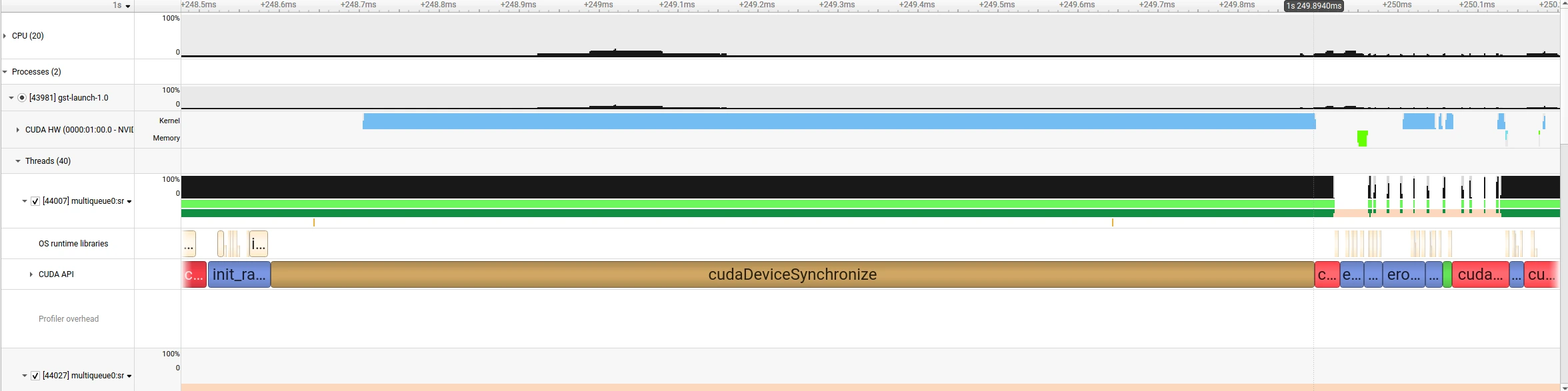
curandState| Resolution | curandState Allocation Size |
|---|---|
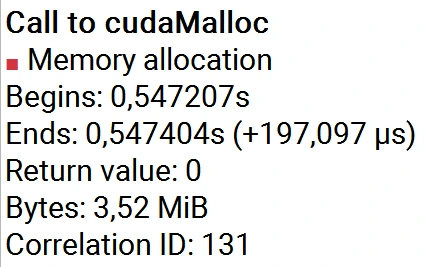
| 320×240 | ~3.5 MB |
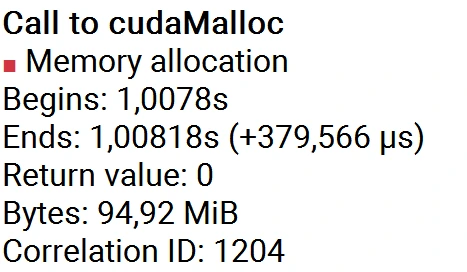
| 1920×1080 | ~94.9 MB |
| cuRAND Allocation (320×240) | cuRAND Allocation (1080p) |
|---|---|
 |
 |
Solution: A Linear Congruential Generator (LCG) computed on the fly from the pixel index and frame number — zero additional VRAM bytes required.
Throughput cuRAND |
Throughput fast_rand |
|---|---|
 |
 |
Opti 4 — Hysteresis Thresholding in Shared Memory (×23.5)
Hysteresis propagation requires multiple passes until convergence. Without optimization, each iteration triggers CPU/GPU synchronizations and VRAM bandwidth saturation.
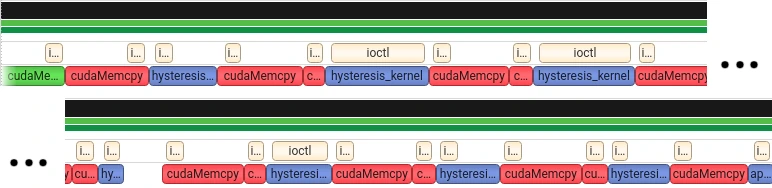
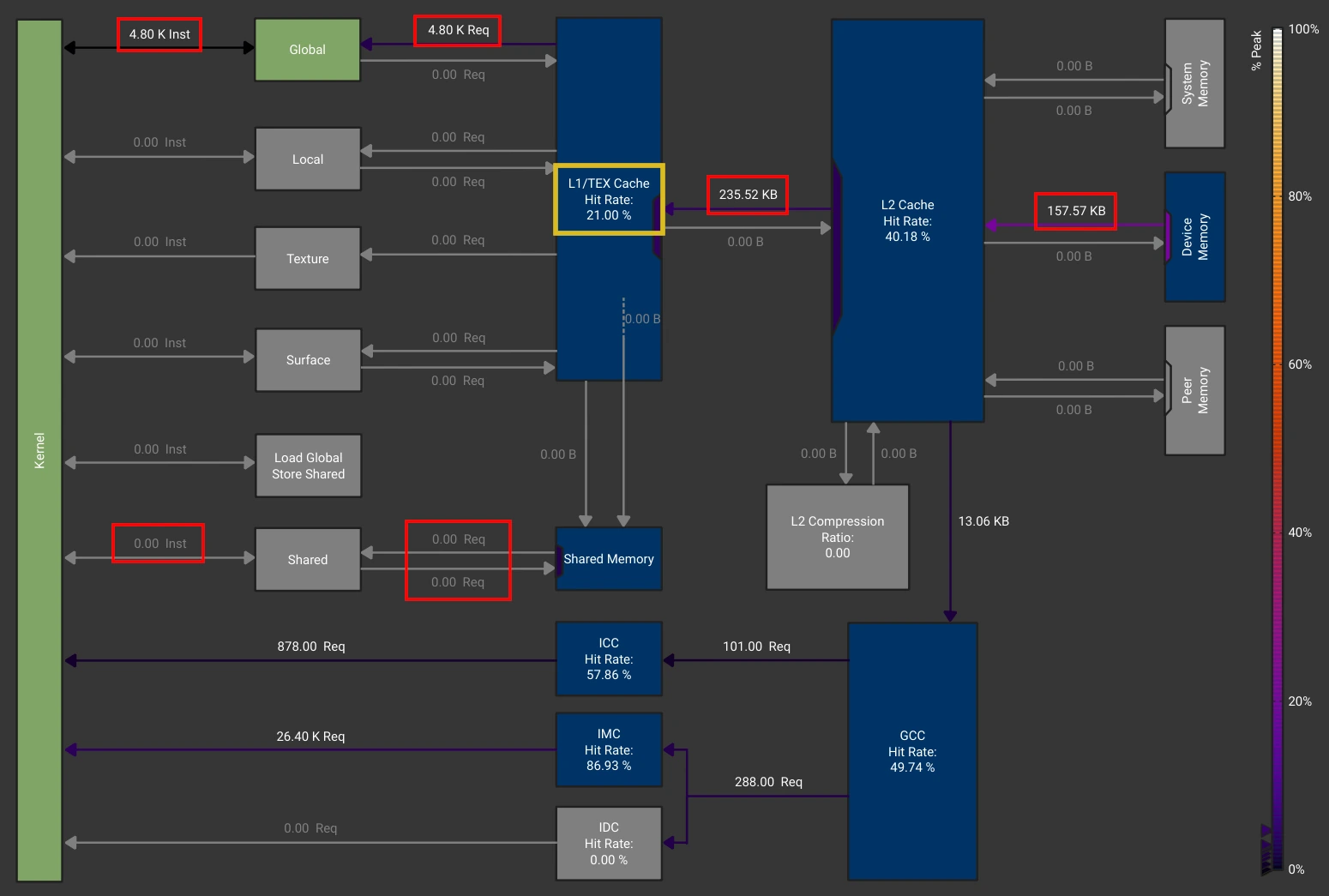
Solution: 16×16 tiling in Shared Memory with a +1 pixel halo. Propagation from strong pixels to neighboring weak pixels occurs locally, without global VRAM accesses.
| VRAM Analysis Before | VRAM Analysis After |
|---|---|
 |
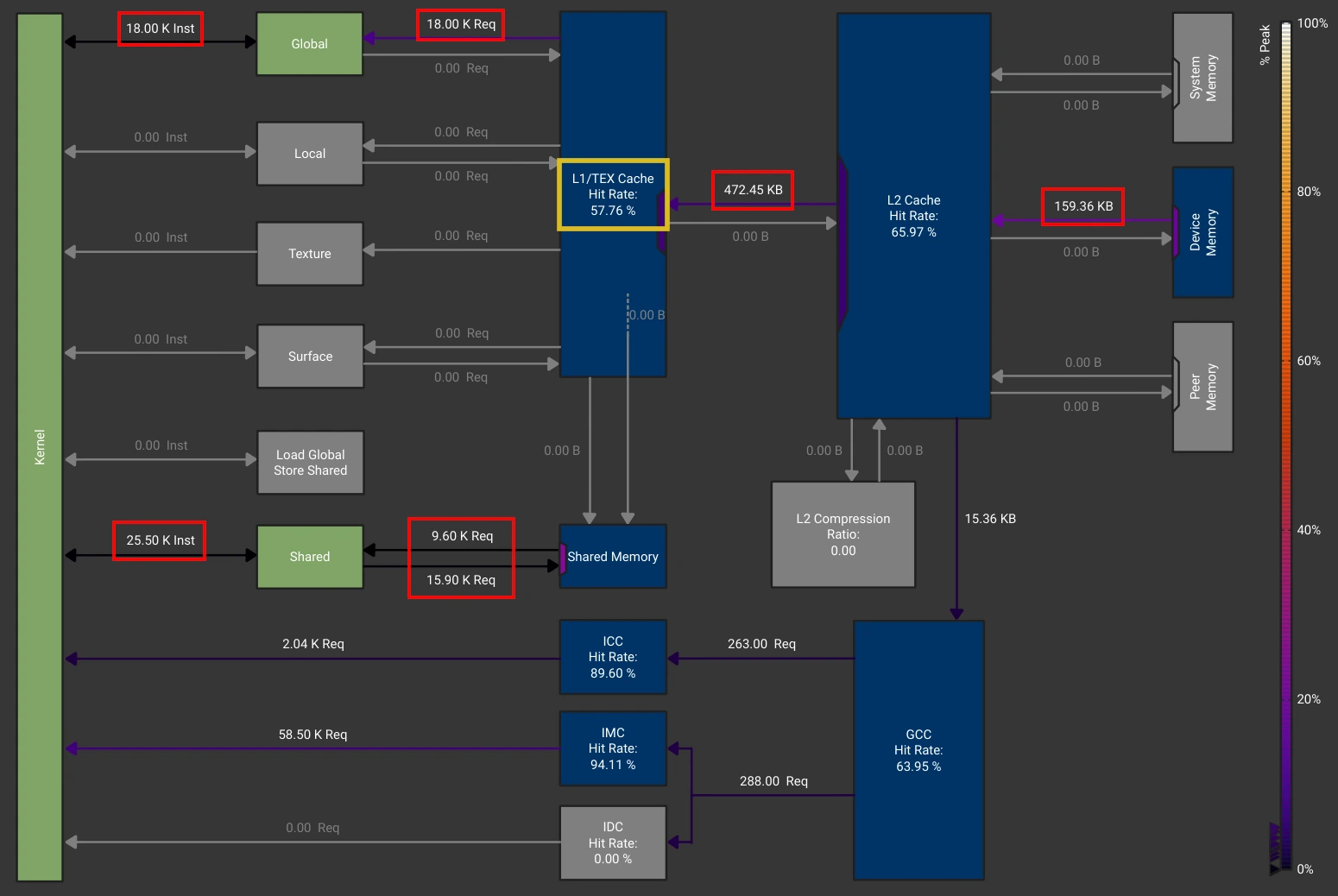 |
Result: VRAM requests were reduced 8-fold (from 139 K to 17.7 K per iteration), adding +26% pure execution speedup on this kernel alone.
Opti 5 — Tiled Morphological Opening (×24.1)
Erosion and dilation read 29 neighboring pixels per thread directly from global VRAM. Tiling into Shared Memory (halo 2×R) with disk offsets stored in Constant Memory cut VRAM traffic in half (10.69 → 5.44 GB/s).
Opti 6 — 32×8 Block Geometry (×24.5)
Nsight Compute revealed that a 32×8 block geometry (256 threads) aligns perfectly with the size of a CUDA warp (32 threads) in the horizontal direction, maximizing memory coalescence during image row accesses.

CUDA Parallel Design Patterns Analysis
Within the GPU architecture of the project, we evaluated key parallel design patterns:
- Stencil Pattern ✅: Heavily used for morphological opening and hysteresis (local neighborhood in Shared Memory).
- Reduction Pattern ❌: The hysteresis convergence flag (idempotent write
false → true) creates no race conditions — eliminating the need foratomicOr. - Scan Pattern ❌: Unsuited for local pixel-wise operations.
Results & Benchmarks
Summary Table
| Implementation | Time (s) | Throughput (FPS) | Speedup | SSIM Accuracy |
|---|---|---|---|---|
| C++ Reference | 616.78 s | 5.29 FPS | 1.00× | 1.0000 |
| Naive CUDA | 52.72 s | 48.92 FPS | 9.24× | 0.9951 |
| CUDA Lazy Mem + Float | 18.18 s | 95.43 FPS | 18.03× | 0.9950 |
| CUDA Fast Random | 17.01 s | 98.96 FPS | 18.70× | 0.9950 |
| CUDA Shared Mem Hysteresis | 10.80 s | 124.34 FPS | 23.49× | 0.9949 |
| CUDA Tiling Opening | 10.65 s | 127.57 FPS | 24.10× | 0.9949 |
| CUDA Final (32×8 Blocks) | 10.56 s | 129.51 FPS | 24.47× | 0.9949 |
Global Performance Comparison
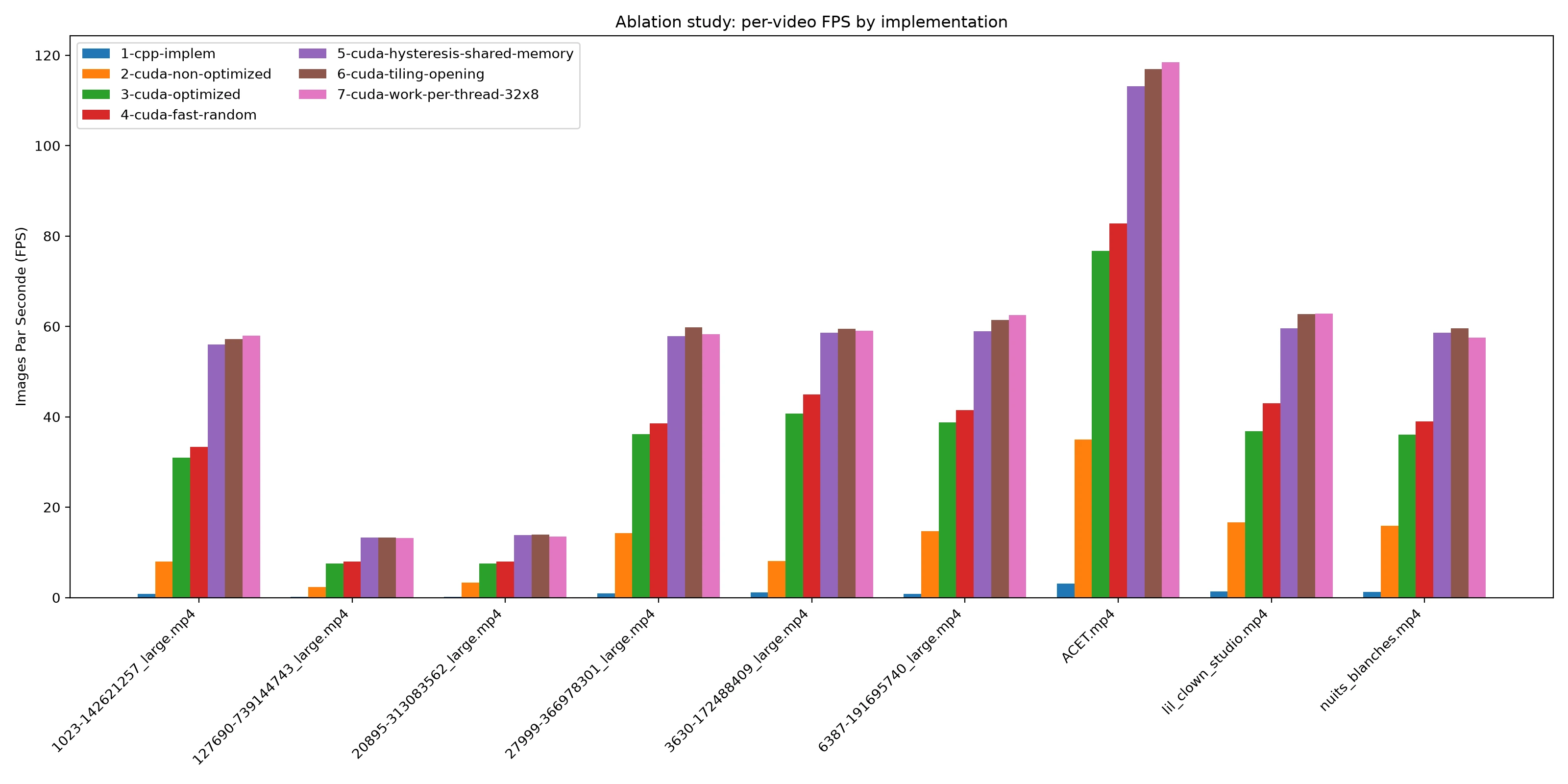
From 5.29 FPS to 129.51 FPS: a ×24.47 speedup with near-perfect visual accuracy (SSIM = 0.9949), proving that every optimization stage — from memory layout to random number generation — contributed directly to the final result.